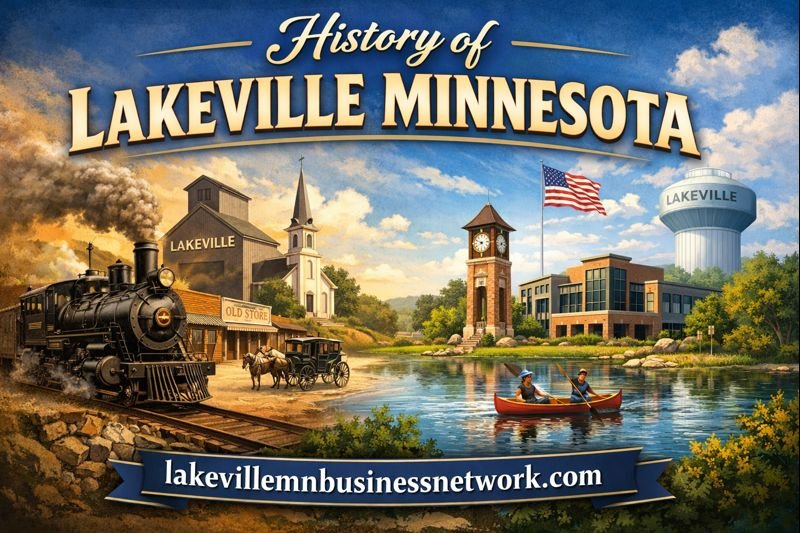
History of Lakeville, Minnesota
From Prairie Settlement to Thriving Twin Cities Suburb
Early Beginnings (1851-1858)
1851
Before European settlement, the land that would become Lakeville was home to the Sioux (Dakota) people. In 1851, the Sioux ceded most of southern Minnesota through the Treaty of Traverse des Sioux, opening the region to settlers from the east.
1853
Captain William B. Dodd, who came from the east to serve the military forts in the Minnesota Territory, designed and directed the construction of a crucial road connecting the military forts in St. Paul to the southern forts in Faribault. This road, later named Dodd Road after Captain Dodd was killed in the Sioux Uprising of 1862, still bisects present-day Lakeville.
“In 1855, J.J. Brackett, a Saint Paul lumber baron and mail carrier, chose Lakeville as an ideal site for a town because it was roughly halfway between St. Paul and St. Peter on the military road. He platted 250 acres and named it Lakeville because of its proximity to Prairie Lake—now known as Lake Marion.”
The Village Takes Shape (1855-1878)
1855
J.J. Brackett had 250 acres surveyed and platted, calling the place Lakeville due to its proximity to a pretty little sheet of water he named Prairie Lake. By 1858, the tiny town of Lakeville, located near the intersection of today’s County Road 50 and Dodd Boulevard, contained a general store, two hotels, a boarding house, a blacksmith shop, a saloon, and a shoe shop.
1858
Lakeville Township was officially established as a governing unit. The village was in flourishing condition with settlers building homes and opening businesses.
1869
When the Hastings and Dakota Railroad line was completed, railroad officials tried to buy land in Lakeville to build a depot. When the owner refused to sell, the railroad purchased 20 acres a half-mile to the east, put up a platform, and named the area Fairfield. It wasn’t long before existing businesses moved from the original townsite to Fairfield to be near the railroad.
1878
After nine years of effort, business owners and residents successfully changed the name from Fairfield back to the Village of Lakeville. They sought incorporation separate from Lakeville Township to form their own government. Agriculture was the major industry, with several grain mills handling crops from area farmers and a creamery that made cream into butter.
The Dan Patch Era (1907-1916)
Lakeville gained national notoriety when Colonel Marion Willis Savage expanded his entertainment business into the community. Savage, a promotion genius who owned the famous racehorse Dan Patch, had built a fortune through his International Stock Food Company and various other ventures.
1907-1910
Savage filed articles of incorporation for the Minneapolis, St. Paul, Rochester, and Dubuque Electric Traction Company—nicknamed the “Dan Patch Line” after his champion racehorse. He purchased 40 acres on the east side of Prairie Lake, renaming it Lake Marion after himself.
July 4, 1910
Antlers Park opened on the Fourth of July, becoming one of the premier amusement destinations in the region. The park featured amusement rides, a large dance pavilion, a hotel, picnic areas, a bathing beach, tennis courts, baseball diamonds with grandstands, and a nine-hole golf course. The name “Antlers Park” came from a local tale of a fisherman surprised that his big catch turned out to be a pair of antlers.
The Dan Patch Line ran twelve scheduled trips daily between Minneapolis and Lakeville, with the forty-minute journey costing just forty-five cents. The luxury cars featured leather seats, stained glass upper windows, and richly carved and inlaid wood interiors. By summer 1912, these trains made 19 scheduled runs each day on weekends.
Dan Patch himself was a legendary pacer who broke world speed records at least 14 times, finally setting the world record for the fastest mile by a harness horse at 1:55 during a time trial at the 1906 Minnesota State Fair before 90,000 spectators.
1916
Tragedy struck when Dan Patch died unexpectedly on July 11, 1916. Marion Savage, devastated by the news, died just days later. The Dan Patch Line, already struggling financially, went into receivership. Antlers Park was sold at auction for $16,000 to George P. O’Rourke, an engineer with General Electric who added an 18-hole golf course east of the park.
🚀 The Inventor’s Velocity
Professional Web Development & Digital Marketing
Early Settlers and Community Life
The rural landscape of early Lakeville attracted farmers, with a high proportion being Scandinavian immigrants. From 1840 to 1895, Danes reportedly outnumbered Norwegians in the area. Other ethnic groups included Irish, Scots, and English settlers who spread out from Hamilton Landing and Burnsville.
Agriculture dominated the economy, with farmers producing corn, soybeans, and dairy products. The railroad brought essential services—freight was shipped in and out from the Hastings & Dakota Railroad Depot, including cream shipped to the Lakeville Creamery from across Minnesota and the Midwest, and butter shipped out by the creamery.
One beloved community staple was Enngren’s Grocery, which opened in 1906. Founded by Jerry Enngren, the store became an icon that sold locally grown produce and ensured that seniors and those in need received free turkeys for Thanksgiving.
At the turn of the 20th century, Lakeville’s population stood at just 373 residents. The community remained close-knit, with the village boasting churches, schools, and the essential services of small-town Minnesota life.
Modern Growth (1967-Present)
1967
Lakeville Township was officially incorporated as the City of Lakeville. The community remained primarily agricultural for years, as postwar development didn’t immediately absorb Lakeville and Interstate 35 had not yet been completed.
1972-1974
The City began taking ownership of Antlers Park. Some original structures still existed at the time of purchase, but only the historic dance pavilion was preserved for public use. The depot that had served the Hastings and Dakota Railroad closed in 1969, exactly 100 years after it was built.
Late 20th Century
The completion of Interstate 35 and the gradual expansion of the Twin Cities metropolitan area brought rapid residential and commercial development to Lakeville. Rising land costs in the central metro area transformed Lakeville into one of the fastest-growing cities in Minnesota.
2005
The Lakeville School District opened its second high school, Lakeville South, to accommodate the growing population. Lakeville North was named a Blue Ribbon school of excellence in 2009.
2015
Post Consumer Brands established its headquarters in Lakeville, adding to the city’s growing commercial presence alongside the established Airlake Industrial Park.
2020 Census
Lakeville’s population reached 69,490, making it Minnesota’s tenth-most populous city and the largest city in Dakota County. The city now encompasses nearly 37 square miles.
May 22, 2024
The newly renovated Antlers Park reopened after extensive improvements. The John Hennen Pavilion was constructed in the footprint of the original dance pavilion, with railroad elements worked into the design of the plaza and playground—a fitting tribute to the Dan Patch era.
Quick Facts About Lakeville
- Located approximately 20 miles south of both downtown Minneapolis and St. Paul along Interstate 35
- The Vermillion River, designated as a trout stream by the Minnesota DNR, flows through Lakeville
- Lakeville is served by Airlake Airport, a regional reliever airport managed by the Metropolitan Airports Commission
- The Parks & Recreation Department maintains 62 public properties covering over 3,000 acres
- Three school districts serve Lakeville: District 194 (Lakeville), District 196 (Rosemount-Apple Valley-Eagan), and District 192 (Farmington)
- Captain Dodd, for whom Dodd Road is named, was killed in the Sioux Uprising of 1862
- Lake Marion was originally called Prairie Lake until renamed after Marion Savage in 1908
Lakeville, Minnesota—from a humble halfway point on a military road to one of the Twin Cities’ most vibrant communities.